















영자신문읽기[고급] 신문 속 다양한 세상 이야기를 이제 영어로 만나보세요!


 |
|  |

Seoul-Washington intelligence ties appear strained as security talks continue to stall
2026-10-14
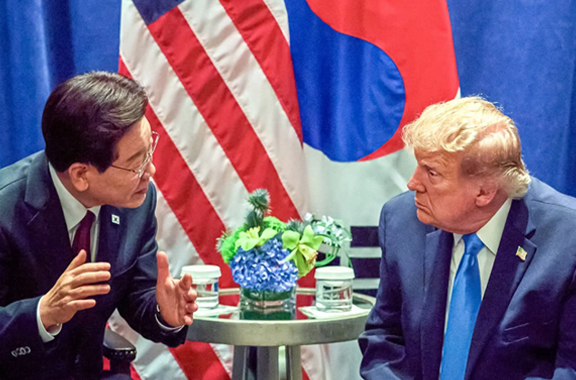
Strains in the South Korea-U.S. alliance persist despite a $350 billion investment deal, as signs emerge that Washington may be distancing itself from Seoul’s National Intelligence Service.
The Lee Jae Myung administration had expected that resolving delays in South Korea’s investment in the United States would help accelerate security talks, including discussions on acquiring nuclear-powered submarines. But as of Friday, the talks had made no concrete progress.
At their summit in New York on Sept. 22, Lee and U.S. President Donald Trump agreed to pursue follow-up talks on the submarines, uranium enrichment and spent nuclear fuel reprocessing, shipbuilding cooperation and the transfer of wartime operational control. More than two weeks later, even a schedule for those discussions has yet to be set.
“We are in a situation where we should put considerable effort,” a government official said. Adding to the concerns, the U.S. Department of State has held up a visa for Rep. Jung Chung-rae, the former leader of the ruling Democratic Party (DP). Jung was preparing for an official visit to audit South Korean diplomatic missions in the United States as part of the National Assembly’s annual oversight process.
DP leader Kim Min-seok protested the delay after it became public. “I express strong regret over the delay in issuing a visa to a four-term lawmaker and preceding leader of the ruling party,” Kim said.
Although the Blue House and the government publicly maintain that there are no problems in the relations, figures within the ruling camp have struck a more cautious tone.
“Several issues remain between South Korea and the United States,” a senior ruling camp official said. “The biggest issue right now is cooperation between the intelligence agencies.”
Friction between the two countries’ intelligence agencies came to light following the fifth trilateral working group meeting of South Korean, U.S. and Japanese diplomatic officials on North Korean cyberthreats, held in Washington in June.
In an unusual move, the U.S. side excluded the National Intelligence Service (NIS) from the meeting, communicating the decision both verbally and in writing. Attendance across the three delegations consequently fell to 60 from the 70 at the previous meeting.
It also recently emerged that a visa had been delayed for an NIS employee preparing to take up a post at the South Korean Embassy in Washington.
The NIS described its exclusion from the meeting as “a matter already in the past” and said the visa delay was “entirely unrelated to South Korea-U.S. intelligence cooperation.” The explanations, however, have not dispelled questions.
“It is true that problems with intelligence cooperation have persisted from the beginning of this year until now,” a senior ruling camp official said.
Some observers suggest that South Korea’s dispute with Ukraine over the repatriation of North Korean prisoners of war has contributed to the friction.
“Some on the U.S. side see the government’s hard-line response over the repatriation of North Korean prisoners of war, including summoning the Ukrainian ambassador, as a possible attempt by Seoul to open a path to inter-Korean engagement through Russia,” a diplomatic source said.
“This is adding pressure to a South Korea-U.S. relationship that was already difficult to manage.”
The series of news reports involving the NIS, and the agency’s point-by-point denials, has also been unusual.
After a report Friday alleged that U.S. Commerce Secretary Howard Lutnick had conveyed distrust of the NIS to Industry Minister Kim Jung-kwan during investment negotiations, both the intelligence agency and the Industry Ministry said the claim was untrue.
The NIS also denied a report that its director, Lee Jong-seok, had argued with Foreign Minister Cho Hyun at a meeting of the National Security Council’s standing committee in August.
“No such incident occurred,” the agency said.
A day earlier, the NIS expressed strong regret over a report that Lee had been denied a visit in March to the National Geospatial-Intelligence Agency (NGA), a U.S. intelligence agency under the Defense Department.
“There was never a plan to visit the NGA,” the NIS said.
The stream of unfavorable reports about an agency and its director who generally operate outside public view has led some in the ruling camp to focus on possible internal divisions at the NIS.
Some suspect that NIS employees dissatisfied with Lee and the current leadership have discussed sensitive matters with former colleagues, with those accounts then reaching politicians or the media.
“There is only one place that could be leaking these stories to the press, isn’t there?” a ruling camp official said.
“The NIS director, who comes from an academic background, has not fully established control over the organization, allowing sensitive information to leak,” an intelligence source said. “Declining approval ratings for the administration and growing public criticism of government policies may also have played a part.”

| 번호 | 기사목록 | 날짜 | 조회수 |
|---|---|---|---|
| >> |
| 2026-10-14 | 123 |
| 59 |
 Juvenile theft cases up 76% since 2021, with unmanned stores a key factor
Police apprehended two teenagers after a string of thefts at unmanned ice cream stores in Seoul and Goyang, Gyeonggi, last December. | 2026-10-13 | 398 |
| 58 |
 | 2026-10-12 | 348 |
| 57 |
 | 2026-10-11 | 283 |
| 56 |
 | 2026-10-10 | 151 |
| 55 |
 | 2026-10-09 | 179 |
| 54 |
 | 2026-10-08 | 247 |
| 53 |
 | 2026-10-07 | 283 |